Tuesday Tip of the Week: It is a Myth That Any Pharmacy Benefit Manager Offers Better Price Savings Because of Their Size (Rerun)

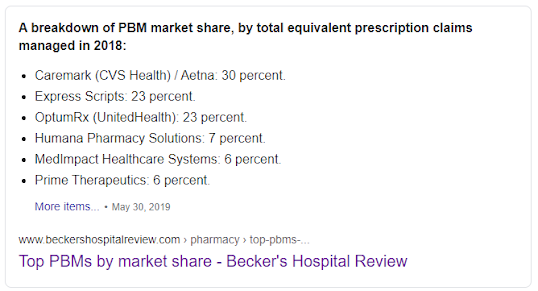
 It is a myth that the Big 6 (ESI, CVS, Optum, Humana, MedImpact and Prime) offers better price savings just because of their size. The myth is often perpetuated by the old guard who for a long time have personally benefited from overpayments received from opaque PBM business practices. We can’t expect the old guard to bite the hand that feeds them, can we?

Sure, the Big 6 have more purchasing power, but their clients often don’t realize the full benefit. For example, if our rebate aggregator pays us, TransparentRx, a $3000 rebate for drug “A” every penny goes back to the client with an audit trail. The audit trail includes claim level detail (e.g. claim number, NDC, date and rebate amount) for every drug which earned a rebate payment. 

The Big 6 might earn $4000 on that same drug, but retains $1200 in-house, for instance. The plan sponsor pockets an additional $200 working with a radically transparent, albeit smaller, PBM. Without an audit trail a PBM could earn a rebate on a drug and not share any of those dollars with the plan sponsor who actually earned it. A similar scenario plays out in mail, specialty and retail pharmacy networks.
Price quotes (RFPs etc…) are simply an estimate of what the plan sponsor would have spent had the historical utilization matched that of the proposing PBM (a lot in this sentence). Furthermore, the future actual cost is unknown. As a result, the plan sponsor’s PBM contract is the most important tool to address the actual level of spend – not cost projections. Non-fiduciary PBMs know full well what you like to see in proposals. When contract language is opaque, the non-fiduciary PBM starts to eat away at the proposed savings, i.e. discount and rebate guarantees, as soon as you go live.

If you’ve never considered the PBM management fee in how you procure pharmacy benefit management services, watch this free webinar. The PBM management fee isn’t what you think it is. It is largely the undisclosed fee a PBM charges for providing their services to plan sponsors. For non-fiduciary PBMs, the bulk of this fee is buried in the final plan pharmacy cost. It goes without saying, the contract is king.

Tuesday Tip of the Week: Three Myths about PBM Pricing Every Employer-Sponsored Plan Should Know

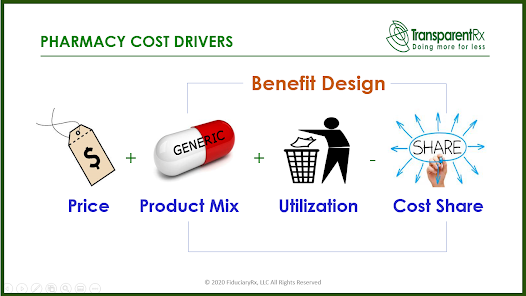
Employer-sponsored plans that prioritize price risk poor clinical outcomes and higher overall costs in their pharmacy programs. Equal focus on all four pharmacy cost drivers will always produce the best results. Price is just one indicator of pharmacy benefits management program success, but it is one that can also hide problems. 
 
On the positive side, lower spend can be the result of better product mix and efficient drug utilization driven by improved formulary management. Here are three myths that have developed in the market and reasons why placing equal emphasis on each of the four pharmacy cost drivers will generate greater value at a lower cost over the long term.
 
1. Rebates are one of the Top 2 factors in lowering employer-sponsored pharmacy benefit plan costs.” The employer faces a double whammy on rebates: (1) rebates may be kept by the PBM (2) rebates are offered only on expensive drugs. Almost without exception the most heavily advertised and rebated drugs have therapeutic alternatives which cost up to 90% less than the rebated products. An employer may think it need not worry about this structure since it receives 90%+ of the rebates. Are there other fees paid to the PBM by the manufacturer that are relabeled and therefore are no longer considered a “rebate”? Does the employer even have access to the right information to make these decisions?
 
2. Pass-through and Transparent PBM business models provide similar levels of transparency and price. Non-fiduciary PBM companies have learned how to leverage the purchasing power of the unsophisticated plan sponsor purchaser to their financial advantage. Consequently, pass-through and so called transparent PBM business models don’t let you in on what their management fee amounts to. That is a big big problem. Unlike admin fees, management fees are not easily quantifiable primarily because non-fiduciary PBMs don’t want employer-sponsors to know just how much their fees are contributing to your costs. The full-disclosure and fiduciary-model PBM will disclose to self-insured employers their management fee or the part of negotiated discounts it will keep. The lower this fee the less employers pay plain and simple. A reasonable PBM management fee bends the cost trend whilst delivering similar levels of service and outcomes. 
 
 
3. Benefit design is less important than pricing guarantees such as AWP discounts and rebates. Never once during hundreds of RFPs has any consultant or broker ever asked us for a signature ready benefit design as part of our response. I’ve not taken a poll so I don’t know the reason. Maybe it is because some believe benefit design doesn’t have a big role in determining cost. If that is the case, nothing could be further from the truth. I would be asking for a benefit design to be submitted as if we were going live with it. In pharmacy cost drivers, price is 1A and benefit design is 1B. Benefit design includes but is not limited to elements such as formulary, network configuration and member cost-sharing arrangements. Aside from copayments and deductibles (cost-sharing) most plan sponsors know little else about their benefit design and have left it up to the PBM to decide. When the PBM is non-fiduciary that could lead to significant overpayments.
 
There are a lot of bad actors [not just PBMs] in the benefits industry using employers’ bank accounts as their personal ATM. Much can be done by non-fiduciary PBMs to improve the level of transparency provided to purchasers of PBM services. Without a trained-eye reviewing PBM contracts, most companies are at the mercy of PBMs who are essentially given a blank check. I’m not taking purchasers of PBM services off the hook either. Continuous learning is essential to running an efficient and cost-effective pharmacy benefit management program.

Tuesday Tip of the Week: Factor Benefit Design into your PBM Scorecard (Rerun)

Factor in the actual benefit design, not questions about benefit design, into your PBM scorecard. At a minimum, it should be the same form the PBM uses to set your group up in the back-office. Sometimes even the PBM’s benefit design form excludes important details, such as DAW codes, so be careful. If important information is missing get it included especially when that information contributes to your cost. 
 
Click to Learn More
 
Never once during hundreds of RFPs has any consultant or broker ever asked us for a signature ready benefit design as part of our response. I’ve not taken a poll so I don’t know the reason. Maybe it is because some believe benefit design doesn’t have a big role in determining cost. If that is the case, nothing could be further from the truth. I would be asking for a benefit design to be submitted as if we were going live with it.
 
Don’t put 50 questions in a RFP around benefit design where important details get lost in translation. Instead, get a copy of a signature ready benefit design and score it as part of the PBMs proposal. Here are some weights I recommend applying to each scorecard:
 
Contract – 40%
 
Benefit Design – 25%
 
References – 10%
 
Questionnaire – 5%
 
Reverse Auction – 15% 
 
Finalist Presentation – 5%
 
In pharmacy cost drivers, price is 1A and benefit design is 1B. Aside from copayments and deductibles (cost sharing) most plan sponsors know little else about their benefit design and have left it up to the PBM to decide. When the PBM is non-fiduciary that could lead to significant overpayments.

Reference Pricing: “Gross” Invoice Cost for Popular Generic and Brand Prescription Drugs (Volume 185)

This document is updated weekly, but why is it important?  Healthcare marketers are aggressively pursuing new revenue streams to augment lower reimbursements provided under PPACA. Prescription drugs, particularly specialty, are key drivers in the growth strategies of PBMs, TPAs and MCOs pursuant to health care reform. 

The costs shared here are what the pharmacy actually pays; not AWP, MAC or WAC. The bottom line; payers must have access to actual acquisition costs or AAC. Apply this knowledge to hold PBMs accountable and lower plan expenditures for stakeholders.

How to Determine if Your Company [or Client] is Overpaying

Step #1:  Obtain a price list for generic prescription drugs from your broker, TPA, ASO or PBM every month.

Step #2:  In addition, request an electronic copy of all your prescription transactions (claims) for the billing cycle which coincides with the date of your price list.

Step #3:  Compare approximately 10 to 20 prescription claims against the price list to confirm contract agreement.  It’s impractical to verify all claims, but 10 is a sample size large enough to extract some good assumptions.

Step #4:  Now take it one step further. Check what your organization has paid, for prescription drugs, against our acquisition costs then determine if a problem exists. When there is a 5% or more price differential (paid versus actual cost) we consider this a problem.

Multiple price differential discoveries means that your organization or client is likely overpaying. REPEAT these steps once per month.

— Tip —
Always include a semi-annual market check in your PBM contract language. Market checks provide each payer the ability, during the contract, to determine if better pricing is available in the marketplace compared to what the client is currently receiving.

When better pricing is discovered the contract language should stipulate the client be indemnified. Do not allow the PBM to limit the market check language to a similar size client, benefit design and/or drug utilization. In this case, the market check language is effectually meaningless.